
I will tell you the same thing I told my grandson Caleb when he asked if the Garmin Striker 4 was worth the money: it depends on how honest you are with yourself about where you fish. I have been fishing Ohio water for about 45 years, most of it out of a 14-foot aluminum jon boat on Caesar Creek Lake and the Great Miami River, and I have owned cheaper fish finders that made me want to throw them in the water. The Striker 4 is not that. It is also not what the glossy pictures make it look like. Here is the plain version.
This is a Garmin review written by a retired machinist who reads the manual because he paid for the unit, not because he enjoys manuals. I am not going to tell you the Striker 4 will change your fishing life. I am going to tell you what it does, what it does not do, and what I would do differently if I were buying today.
The Quick Verdict
The Garmin Striker 4 is the best value in fish finders I have used in 45 years, as long as you fish water shallow enough for its sonar to matter.
Amazon Check Today's Price →The fish finder I keep recommending to guys who fish small water
If you fish a jon boat, a kayak, or the bank, the Garmin Striker 4 is the unit I tell people to buy first. It shows you what is under the boat without making you take a class to read it.
Amazon Check Today's Price on Amazon →How I've Used It
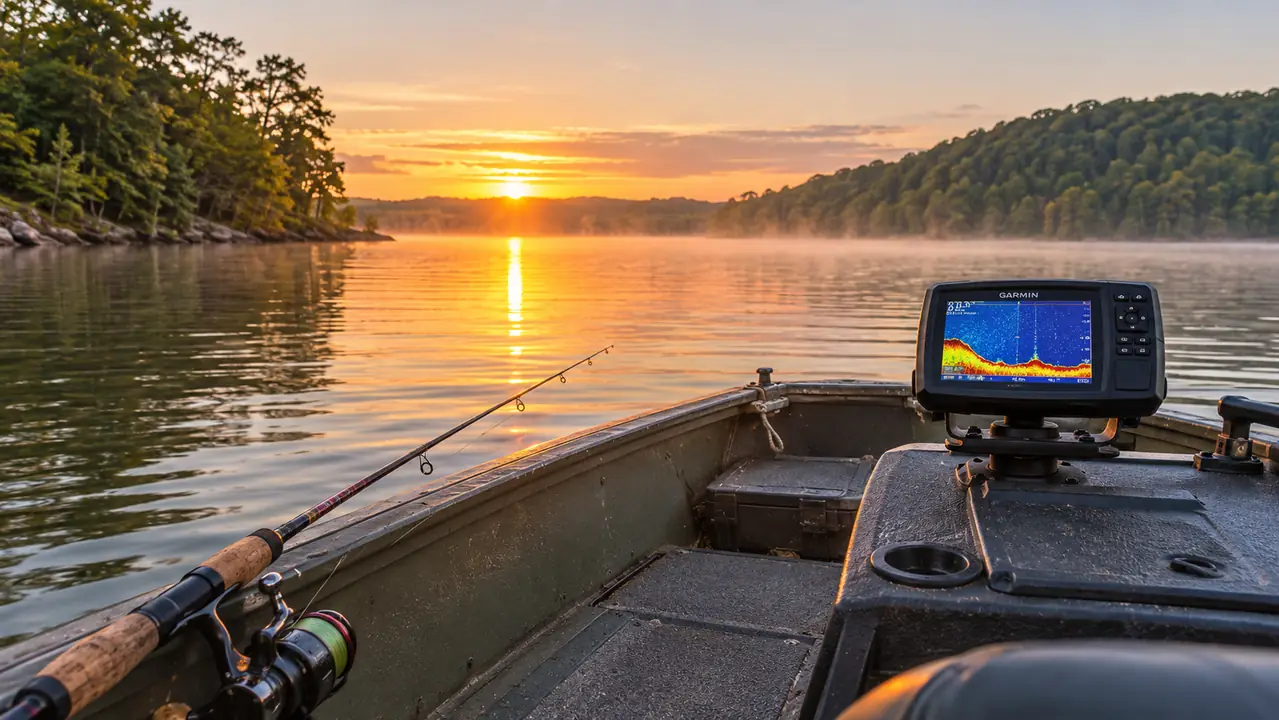
I have had the Striker 4 on my jon boat for the better part of two seasons. It rides on the panel mount in the front of the boat, where I can reach the buttons without taking my eyes off the water. The unit is battery powered, which I will get to in a minute, and it weighs 8 ounces, which is light enough that I forget it is on the mount until I need it. I put it on in early April last year, before the crappie moved up on the banks. The first trip was a Tuesday morning on Caesar Creek with the water still in the low 50s. I had the unit on for maybe ten minutes before it showed me a brush pile I had been casting past for years, a tangle of old Christmas trees sunk off the point. That spot gave up fish all spring, and I would not have found it without the screen.
The display is 3.5 inches diagonal, which sounds small until you remember what we used before: a flasher with a dial and a prayer. The LCD is readable in direct sun, which is more than I can say for a lot of electronics that cost twice as much. The screen itself is 1.9 by 2.9 inches, and the whole unit measures 3.6 by 1.6 by 5.9 inches. It is a small package that does a big job.
I use it mostly on Caesar Creek, where the water is clear enough that the high frequency sonar shows me brush piles and stumps before I hang a jig in them. The unit claims a maximum measuring depth of 1600 feet, and I believe it, because I have never been on water deep enough to test the top end. On the Great Miami, in a deep hole below a riffle, it reads bottom like it is showing me a photograph. One morning last September I ran it across a flat I had fished blind for years and the screen showed a stump I had been casting past the whole time. I marked it, came back three weeks later, and pulled a 4-pound largemouth off that same stump on the first cast. That is the kind of thing the unit does that you cannot appreciate until you watch it do it once.
The first morning I ran it, I made the beginner mistake of watching the screen instead of the water. I idled straight over a flat and nearly put the boat on a stump I had been fishing for years. Caleb still brings that up every time we launch. Now I glance at the LCD, mark what I see, and go back to watching the bank. The unit does its job so quietly that the job is easy to forget. That is the compliment I would give it: it got boring fast, in the best way.
What Nobody Tells You Before You Buy
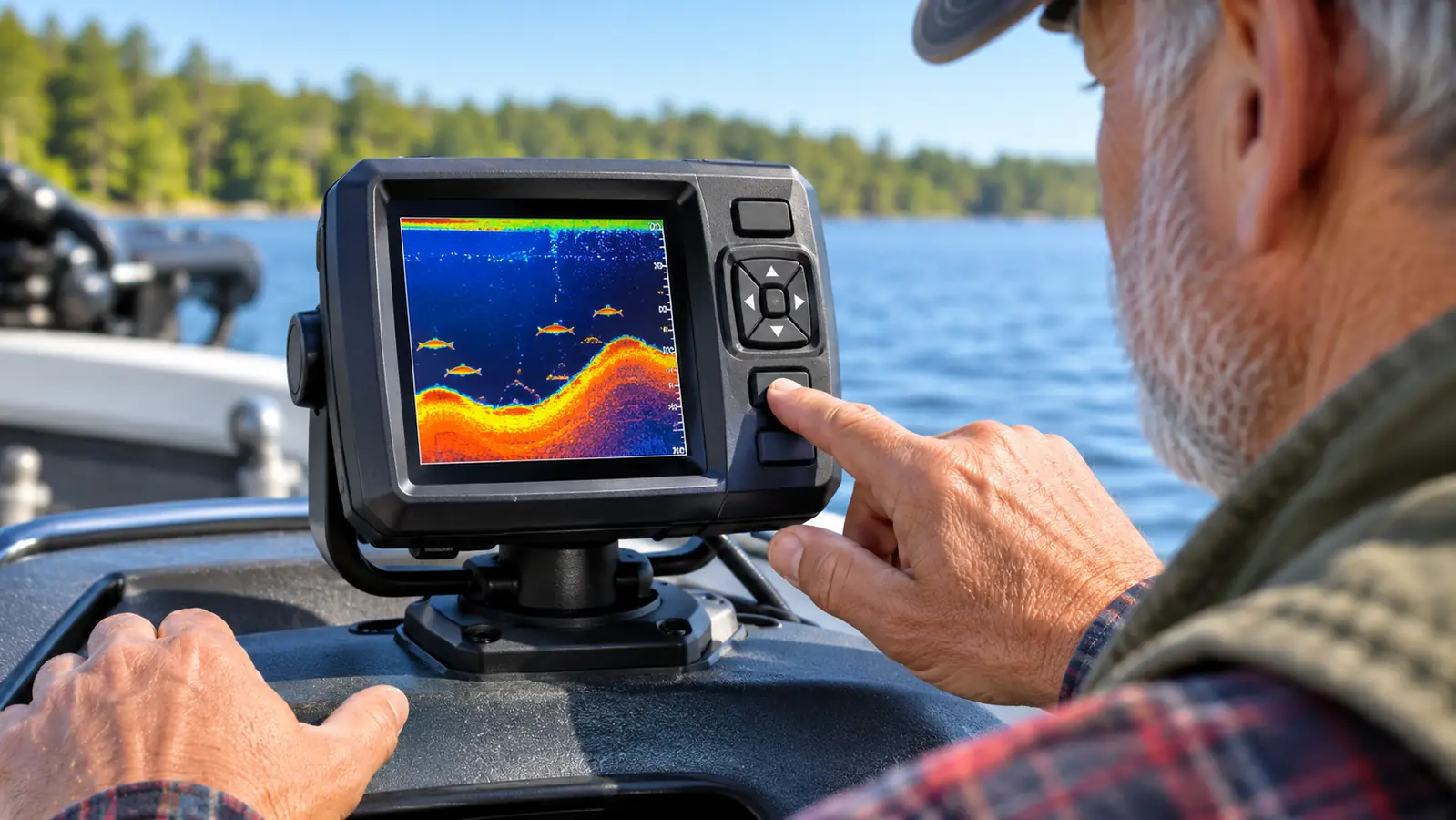
Here is the honest part. The Garmin Striker 4 has a keyed interface with dedicated buttons, and that is a good thing, but the buttons are small and the menu is deeper than it looks. The first time I tried to mark a waypoint, I pressed the wrong button twice and marked a point on the bank instead of the brush pile. The manual is not bad, but it assumes you know what a waypoint is for.
The waypoint map is the feature I use most, and it is the feature nobody mentions in the reviews. You mark a brush pile, a stump, or a dock, and the unit stores it so you can navigate back to it next week. On a reservoir like Caesar Creek, where the water level changes and the fish move with it, that is worth the price of the unit by itself. I have got somewhere north of 40 waypoints saved on mine now, and every one of them is a spot I found by watching the screen instead of guessing. The first one I ever marked was a dock on the west side of the lake, and I still fish it every time the wind is right.
What nobody tells you: the transducer is the heart of the system, and the transducer is where you will spend your time. The included transducer is a transom mount, which means you are screwing it to the back of your boat or building a mount for it. On my jon boat I built a small bracket so the transducer hangs over the side. It took an afternoon, and I used a piece of aluminum angle I had left over from a job at the plant. If you are not handy, budget for a shop to do it, because a transducer that sits crooked will give you a screen full of noise and you will blame the unit. I have watched two guys do exactly that, both of them convinced the Striker 4 was broken out of the box.
The other thing nobody tells you is that the transducer has to stay in contact with clean water at all times. I learned this on the Great Miami in late July, when the current pushed the bracket sideways and the screen went blank. I spent twenty minutes convinced the unit was dead before I realized the transducer was riding an inch above the surface. I reset the bracket, and the picture came back. That afternoon cost me a good stretch of catfishing, and it taught me more about installation than the manual ever did.
The waypoint map is the feature I use most, and it is the feature nobody mentions in the reviews.
The Sonar, in Plain Language
The Striker 4 uses ClearVu scanning sonar, which is a high frequency sonar that shows you more of what is in the water around your boat. In plain language: instead of a single line of bottom, you get a picture of the bottom, the weeds, the stumps, and the fish holding on them. It is like the difference between looking through a keyhole and looking through a window. The first time I saw a crappie school show up as a solid band of marks on the screen, I understood why the old-timers who resisted electronics for years finally gave in. It is not magic. It is just finally being able to see.
The high frequency sonar gives near-photographic detail, but it has a tradeoff. High frequency does not penetrate deep water as well as low frequency. On the Great Miami River, where I fish for channel catfish in holes that run 15 to 25 feet, the Striker 4 reads bottom fine. One evening last July I watched a school of shad roll through a hole at 18 feet, and the screen showed them as clearly as if I had been looking over the side of the boat. On the rare days I fish a deep quarry pond, I lose the crisp picture past about 60 feet. That is not a defect. That is physics, and it is the same for every unit in this price class. What you gain in the water you actually fish is worth what you lose in the water you do not.
The unit has a maximum measuring depth of 1600 feet, which is a spec that sounds impressive and will never matter to you if you fish the way I do. What matters is that the sonar updates fast enough to show you a school of shad before you run over them. It does.
I have also learned to read the screen the way I read the water, which is to say slowly and with suspicion. A mark that looks like a fat bass is often a log. A cluster of marks hugging the bottom is usually a brush pile full of crappie. The Striker 4 gives you the picture, but it does not do the interpretation for you. That part is still on the angler, and I think some buyers expect the unit to be smarter than it is. Last spring I spent a whole morning chasing a mark that turned out to be a submerged shopping cart. By the time I realized what it was, I had burned four hours and a tank of trolling motor battery. The unit was right. I was the one who read it wrong.
The Battery Question
The power source is battery powered, and that is where the honest review gets real. The Striker 4 does not come with a battery. It comes with a power/data cable, and you supply the battery. On my jon boat I run it off a small 12-volt battery that also runs my trolling motor. That works fine, and a full charge lasts me three or four full mornings on the water before I put it on the charger. If you fish from the bank, you will need a portable battery, and that is an extra cost nobody puts in the headline. I keep a small sealed battery in a canvas bag for bank trips, and it runs the unit all day without dropping a bar. Plan for that cost when you budget the purchase, because the surprise is the part that annoys people.
The included components are the Striker 4 fishfinder, documentation, power/data cable, tilt/swivel mount, transducer, and the transom mounting hardware. That is a complete kit, but it is not a turnkey kit. You will spend an afternoon mounting the transducer and figuring out the cable routing. I am a retired machinist, so I enjoyed that afternoon. A lot of guys would have paid someone to do it.
One note on the power/data cable: it is long enough to route cleanly on a 14-foot jon boat, but you still have to decide where the battery lives and how the cable gets from the dash to the stern. I ran mine along the port gunwale and secured it with a few zip ties. It took an hour and it has not moved in two seasons. Do that job once and you will never think about it again. I left myself a little slack at the dash end so the unit can tilt on the mount without pulling the cable, and I put the battery in a plastic box so no bare terminals sit loose in the bottom of the boat. That is the kind of detail a machinist notices and an angler appreciates later.

What I'd Change
If Garmin asked me, I would tell them three things. First, the buttons need to be bigger. The keyed interface with dedicated buttons is the right idea, but my 61-year-old fingers have trouble with the small keys when I am bouncing across a wake. Second, I would put a brighter backlight on the LCD. It is readable, but barely, in the last 20 minutes of legal light. Third, I would include a battery. The unit is battery powered, and the fact that the battery is not in the box is the number one complaint I hear from guys who bought one on my recommendation.
None of those are dealbreakers. They are the difference between a 10 and a 9, and the Striker 4 is a strong 9 for the money.
What I Liked
- ClearVu scanning sonar shows brush piles, stumps and fish in water shallow enough for the way most of us actually fish.
- Waypoint map lets you mark a spot in June and find it again in September, which is worth the price by itself on a reservoir.
- Keyed interface with dedicated buttons means no menus buried behind a touchscreen, and the LCD stays readable in direct sun.
- Weighs 8 ounces and measures 3.6 by 1.6 by 5.9 inches, so it is easy to move between a jon boat, a kayak or a bank setup.
- The 1-year limited warranty and Garmin's reputation mean you are not gambling on a no-name unit.
Where It Falls Short
- No battery in the box, and no way to power it without buying one separately.
- The buttons are small and the menu is deeper than it looks, especially for a first-time user.
- The transducer install is on you, and a poor install will make the unit look broken.
- High frequency sonar loses its crisp picture in deep water past about 60 feet.
- The backlight is just adequate in low light, not great.
Who This Is For
This Garmin is for the angler who fishes a jon boat, a kayak, or the bank, and who wants to know what is under the boat without spending a month's pay. It is for the guy who wants to mark a brush pile in June and find it again in September. It is for the grandfather who wants to hand his grandson a fish finder that does not require a degree in sonar to operate.
It is also for the angler who fishes a mix of water like I do: a reservoir, a river, a farm pond. The Striker 4 does not care what kind of water you put it on. It reads bottom, shows you structure, and stores your waypoints. That is the whole job, and it does it well.
Who Should Skip It
Skip the Striker 4 if you fish water deeper than 100 feet on a regular basis. The high frequency sonar that makes it so good in shallow water is not the tool for deep structure. Skip it if you want a unit with a map of the lake built in. The Striker 4 has a waypoint map, but it does not have a full chartplotter map. You mark your own spots, and you do not get a preloaded map of the bottom.
Skip it if you are not willing to mount the transducer yourself or pay someone to do it. The transducer is the whole game. A fish finder is only as good as its transducer install, and I have seen more than one Striker 4 sitting in a garage because the owner never got the transducer mounted right.
Buy it once, mount it right, and it will outlast your next two boats
The Garmin Striker 4 is the unit I recommend to every angler who asks me what to buy for small water. It is not the flashiest fish finder on the market. It is the one that works, season after season.
Amazon Check Today's Price on Amazon →