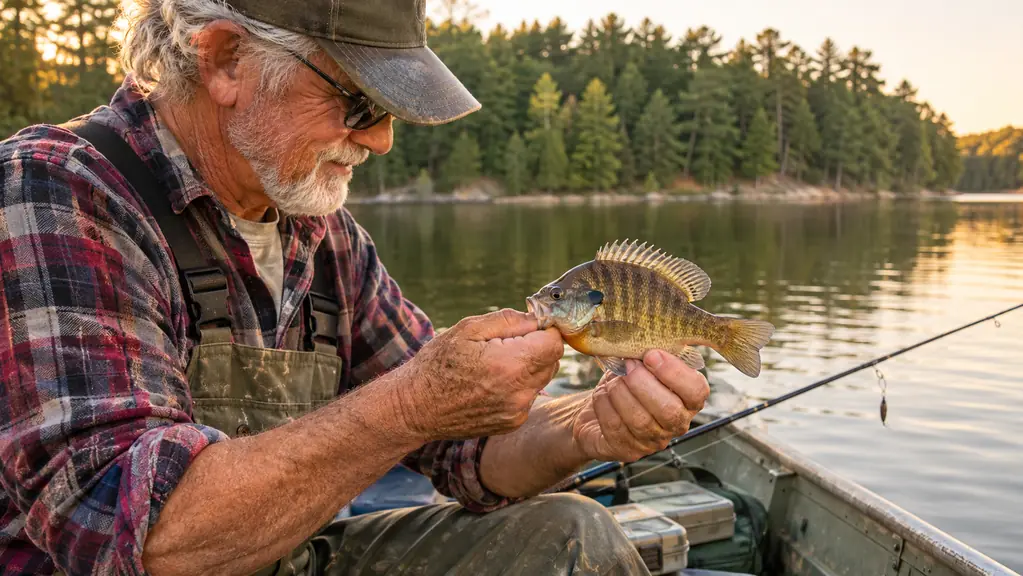
The bluegill hit at the worst possible moment. Caleb set the hook a half second late, and the fish took the little crankbait down deep. By the time he swung it into the jon boat, one hook of the treble was buried past the barb in the corner of the bluegill's mouth, and that fish was mad about it. It flopped twice, threw water across the seat, and then lay there with its gill plates flared and its dorsal spines up, daring us to touch it.
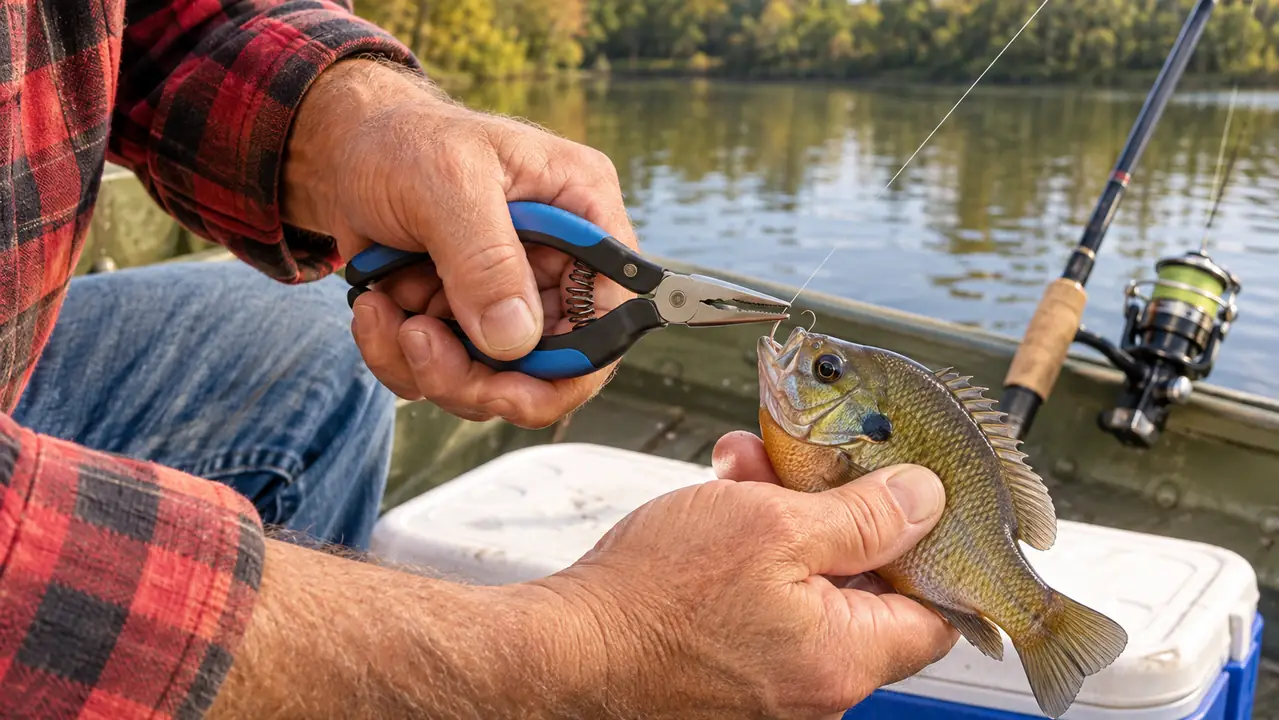
Anybody who has unhooked a bluegill knows the deal. The mouth is small, the gill plates are sharp as a can lid, and the dorsal spines will poke you if the fish rolls. With a treble buried that deep you cannot just grab the hook and pull. You need to crush the barb or cut the hook free, and you need to do it one-handed while the fish does its level best to fling itself across the boat. I reached for the Piscifun pliers that live in the front pocket of my tackle bag.
There was a time I would have handled this with a pair of rusty needle-nose pliers from the toolbox. They worked, after a fashion. You would clamp down on the hook, squeeze, and hope the barb crushed before the fish twisted. Half the time you ended up with a hook in your thumb and a bluegill in the bottom of the boat. I stopped carrying them after I had to cut one out of my own hand with a pocketknife.
I picked up the Piscifun a couple of years ago mostly because the spring-loaded jaws made sense. The handles are aluminum, CNC machined, and the whole thing weighs 3.6 ounces, light enough that it disappears in the bag. The cutters are tungsten carbide, and they are replaceable, which is the sort of detail you only appreciate after you have worn out a cheap pair. It came with a nylon sheath, so it rides in the front pocket without stabbing everything else.
Back to the bluegill. Caleb held the fish steady over the cooler while I worked the cutter down to the hook shank. The jaws stayed open on their own, so I had one hand free to keep the fish from rolling. One squeeze and the treble dropped free. The whole thing took maybe twenty seconds. The bluegill went back over the side, and Caleb looked at me like I had pulled off a magic trick.
Twenty seconds. That is what it took to free a buried treble hook, and the fish swam off unharmed.
A buried treble hook is a ten-minute fight with the wrong tool.
Spring-loaded jaws open one-handed. Tungsten carbide cutters slice through hooks and braid. This is the pair I reach for first on every trip.
Amazon Check Today's Price on Amazon →The part I did not expect to use as much is the braid cutter. I run braid on most of my reels now, and braid is miserable to cut with a knife. It just slides off the blade. The tungsten carbide cutter on the Piscifun goes through it clean, one squeeze, no frayed ends. I have cut more braid in the last year than I did in the previous ten.
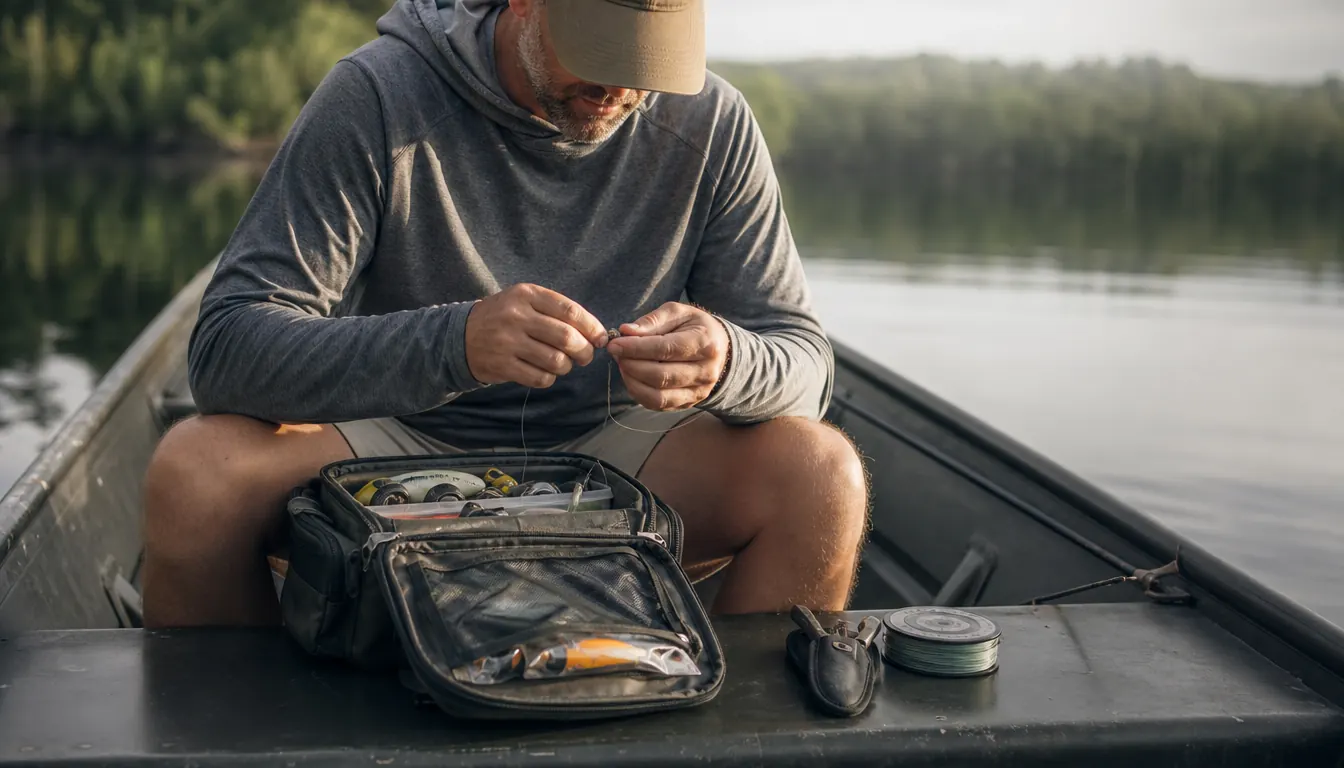
The split ring feature gets used more than I thought it would too. Replacing a split ring on a crankbait used to mean a tiny screwdriver and a fair amount of swearing. Now I pop the ring open with the plier tip, slide the new hook on, and I am back to casting in the time it takes to retie. That does not sound like much until you have three rods to re-rig before dark.
I have had this pair for over a year now. It has been dropped in the bottom of the jon boat, left out in the rain, and used to cut hooks out of a channel cat that had no interest in being helped. The handles still feel solid. The jaws still open on their own. The cutters are still sharp, and when they finally dull, I can replace them instead of replacing the whole tool.
The ergonomic grip sounds like marketing talk until your hands are wet and the fish is flopping. I have dropped plenty of tools over the side of the boat over the years. I have not dropped these. The handles are easy to hold onto even with wet hands, and they do not twist in your grip when you squeeze. For what these cost, that is the kind of detail that keeps a tool in the bag.
What I'd Tell You If We Were Sitting at My Kitchen Table
Here is the plain version. You do not need a box full of fancy gear to catch fish. I have caught plenty on a cane pole with a can of worms. But the tools you reach for when something goes wrong are the ones worth spending money on, because something always goes wrong. A buried hook, a swallowed hook, a snapped line, a fish with a mouth full of sharp edges. That is when a pair of pliers like this earns its keep. It is not the tool that catches the fish. It is the tool that keeps you from bleeding on the one you already caught.
Caleb asked me once why I carry pliers when we mostly fish for panfish and bass. I told him what I will tell you. You never know which trip is going to hand you a fish that needs a hook cut out of it. When that happens, you want a tool that works one-handed, cuts clean, and does not rust in your bag. That is the whole argument for the Piscifun, and it is the whole reason mine has a permanent spot in the tackle bag.
The tool that gets you back to fishing
Spring-loaded jaws, replaceable tungsten carbide cutters, and a 3.6-ounce build that disappears in the bag. This is the pair I reach for on every trip.
Amazon Check Today's Price on Amazon →