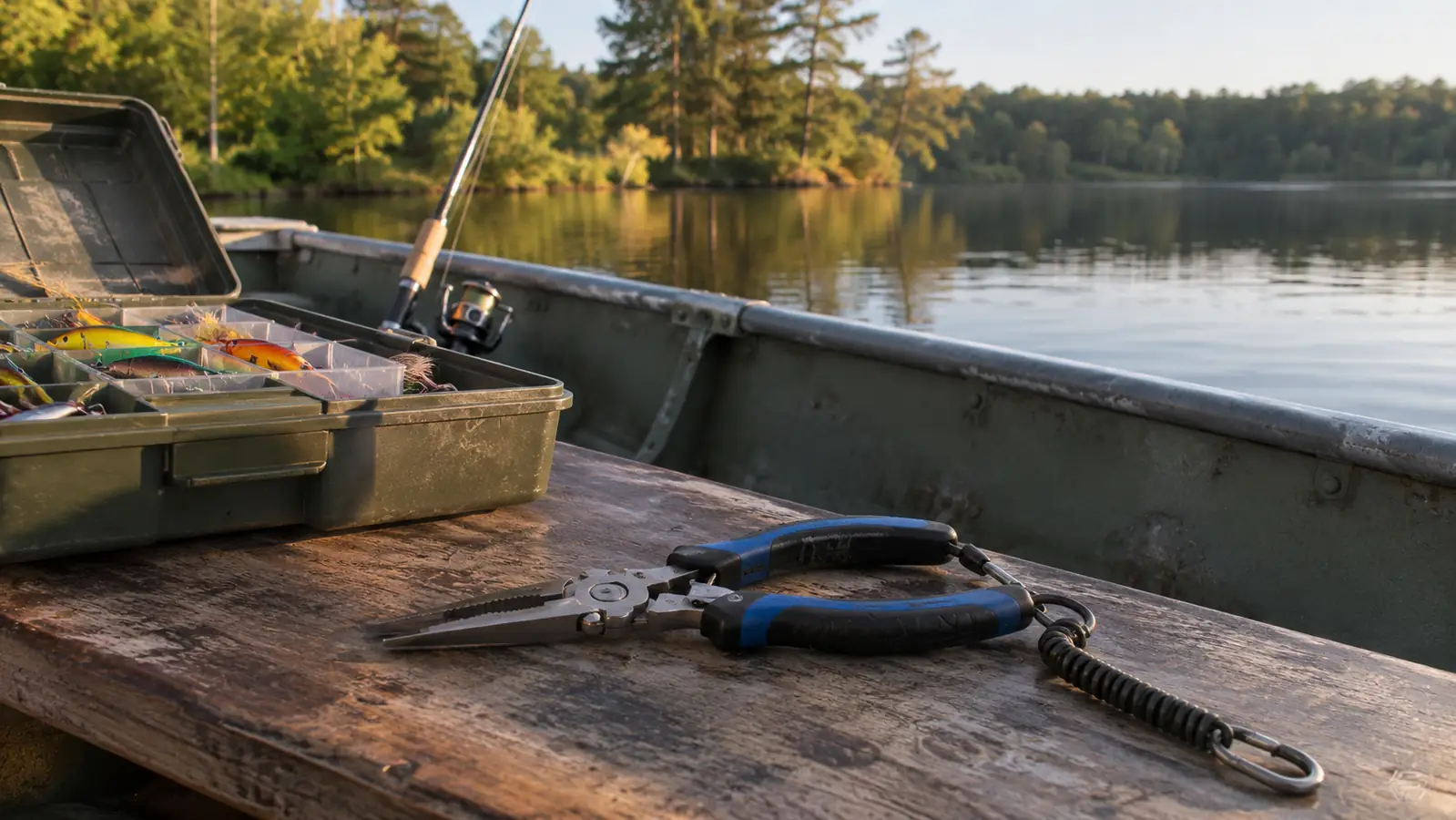
There is no good moment when a hook goes in deep. It happens fast: the fish turns, the hook finds the gill or the back of the throat, and now you are holding a bleeding fish and a hook you cannot even see. I have fished for about 45 years, mostly on Caesar Creek Lake, the Great Miami River, and the farm ponds around Dayton, Ohio, and I have pulled more deep hooks than I can count. The tool that gets them out without killing the fish is a good pair of pliers, and the pair I keep in the nylon sheath on the bench of my jon boat is the Piscifun saltwater pliers. They weigh 3.6 ounces, and they have done this job more times than I care to remember.
The way most people try to get a deep hook out is wrong. They grab the line and pull, which sets the hook deeper, or they work a finger down the throat, which is how you get a treble hook buried in a knuckle. The right way is slower and calmer. You cut the line, you push the hook point the rest of the way through, and you back it out with pliers. This is the order I use, the same one I taught my grandson Caleb, who is thirteen and fishes with me whenever school lets him. It is not fancy. It just works.
The Pliers I Reach For When a Fish Is Deep Hooked
Piscifun saltwater pliers: spring-loaded aluminum jaws, tungsten carbide cutters, 3.6 ounces. They live on the bench of my jon boat, and they have pulled more hooks than I can count.
Amazon Check Today's Price on Amazon →Step 1: Cut the Line Before You Do Anything Else
The first move is to cut the line, not the hook. Reach down and cut the line a foot or so above the fish's mouth, then let the fish hang in the water while you get organized. A long length of line will drag the hook deeper the moment the fish moves, and it gives you something to tangle around your hands, the net, or the boat seat. Cut it short and you are working with a clean situation instead of a mess. I have seen more than one good fish lost because somebody tried to horse a deep-hooked fish in by the line and pulled the hook straight through the gill.
This is where the cutters on the pliers earn their keep. The Piscifun pliers have tungsten carbide cutters, and they will shear through braid without a second thought. I have cut through line that was wrapped around a stick, line wrapped around a net, and line I could barely see because my hands were wet and the light was going. The cutters are also fully replaceable, which matters more than most people realize. A cutter that gets used on hooks and line takes a beating, and cheap cutters do not last a season. Replaceable cutters mean the pliers are the last pair you have to buy.
Keep the fish in the water while you cut if you can. If you are on the bank, kneel at the edge. If you are in the boat, lean over the side. A fish that is already deep hooked does not need extra time in the air, and a fish in the water is calmer, which makes the rest of this easier.
Step 2: Get the Fish Calm and Under Control
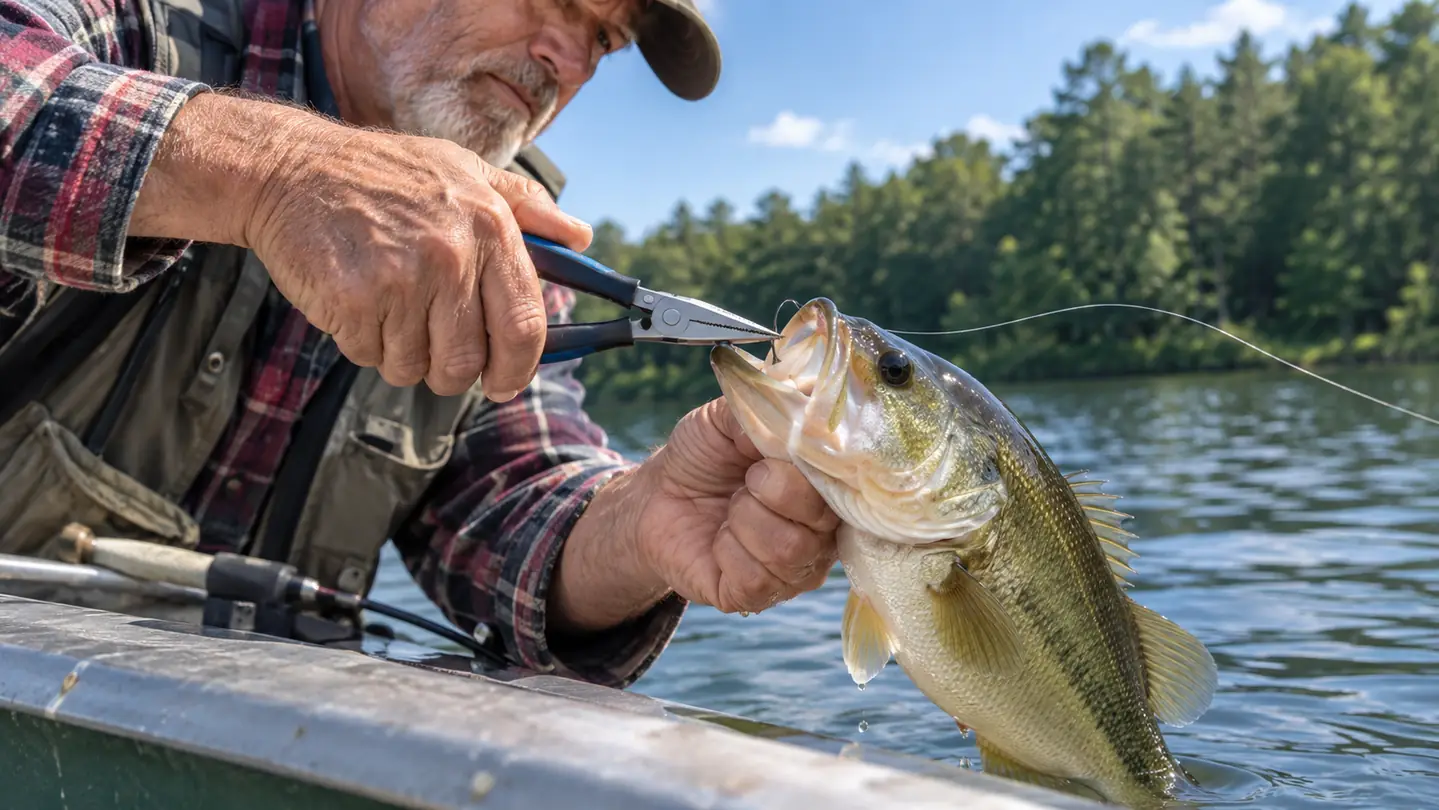
Now you need to handle the fish without making things worse. Wet your hands before you touch it. Lay the fish on its side, either in the water or on a wet surface, and hold it gently but firmly behind the head. Do not squeeze the belly. Do not grip the gills. A fish's organs are not built for pressure, and a squeezed fish is a fish that fights harder and bleeds more.
With the fish controlled, you can work one-handed. The Piscifun pliers are spring loaded, so the jaws stay open on their own. That means you can hold the fish with one hand and bring the pliers in with the other, without juggling. I have used pliers that want to stay closed, and they turn a two-hand job into a three-hand job. The spring is the difference between fumbling around and getting it done while the fish is still in good shape.
Take a breath and look at what you are dealing with. Trace the line to the hook eye, then follow the shank with your eyes. You need to know where the point is before you touch anything. If the point is already through the skin, you are in luck. If it is buried, you have a decision to make, and that is what the next steps are for.
Step 3: Push the Hook Point Through Instead of Pulling It Back
The mistake that kills fish is pulling the hook back the way it went in. The barb is angled to hold, and pulling against it just tears a bigger hole. The better way is to push the point the rest of the way through the skin or the gill plate until the barb comes out the other side. It sounds rough, but a clean push through is a smaller wound than a barb dragged backward through the same hole. I have done this on bass, crappie, and bluegill, and it works on all of them.
Grip the shank of the hook with the pliers, close to the skin, and push in a straight line. Go slow. You will feel the point pop through. Once the barb is visible, you have two options. You can pinch the barb with the pliers and bend it down, or you can clip it off with the cutters. Either way, the hook will now slide backward out of the fish the way it came in, and the wound stays small. That is the whole trick of it: make the hook come out the way it went in.
This is the step where a good pair of pliers shows up. The jaws of the Piscifun pliers are aluminum, and they grip a hook shank without slipping, and the spring keeps them ready between grabs. The ergonomic grip on the handles keeps them in your hand when things get wet. When I am doing this over the side of the boat with one hand on the fish and one hand working, I do not want pliers that need two hands and a prayer. I want the tool that opens itself and bites when I squeeze.
Step 4: Cut the Hook When You Cannot Push It Through
Sometimes you cannot push the point through. The hook is buried in the gills, or the throat, or the fish is bleeding and you need to be honest about what is happening. When that is the case, stop trying to remove the hook whole and cut it instead. Cut the shank near the eye, or cut the point off, and slide the pieces out. Two small cuts beat one big tear every time, and a fish with a small cut has a real chance.
Cutting a hook is hard on cutters. Hook wire is tough, and a cutter that is soft will roll or chip the first time you try. The tungsten carbide cutters on the Piscifun pliers are the sharpest I have used, and they are fully replaceable, which is the part most people do not think about. When they do finally dull, you replace the cutters, not the pliers. That is the difference between a tool you keep for years and a tool you throw away at the end of the season.
And if the hook is in the gills and the fish is bleeding hard, cut the hook as short as you can and get the fish back in the water. A hook left in a fish is not the end of the world. A dead fish is. I have released channel catfish with a piece of hook still in them, and most of them swam off fine. Do not let perfect become the enemy of the fish still alive in your hands.
Step 5: Back Out the Pieces and Get the Fish Back in the Water
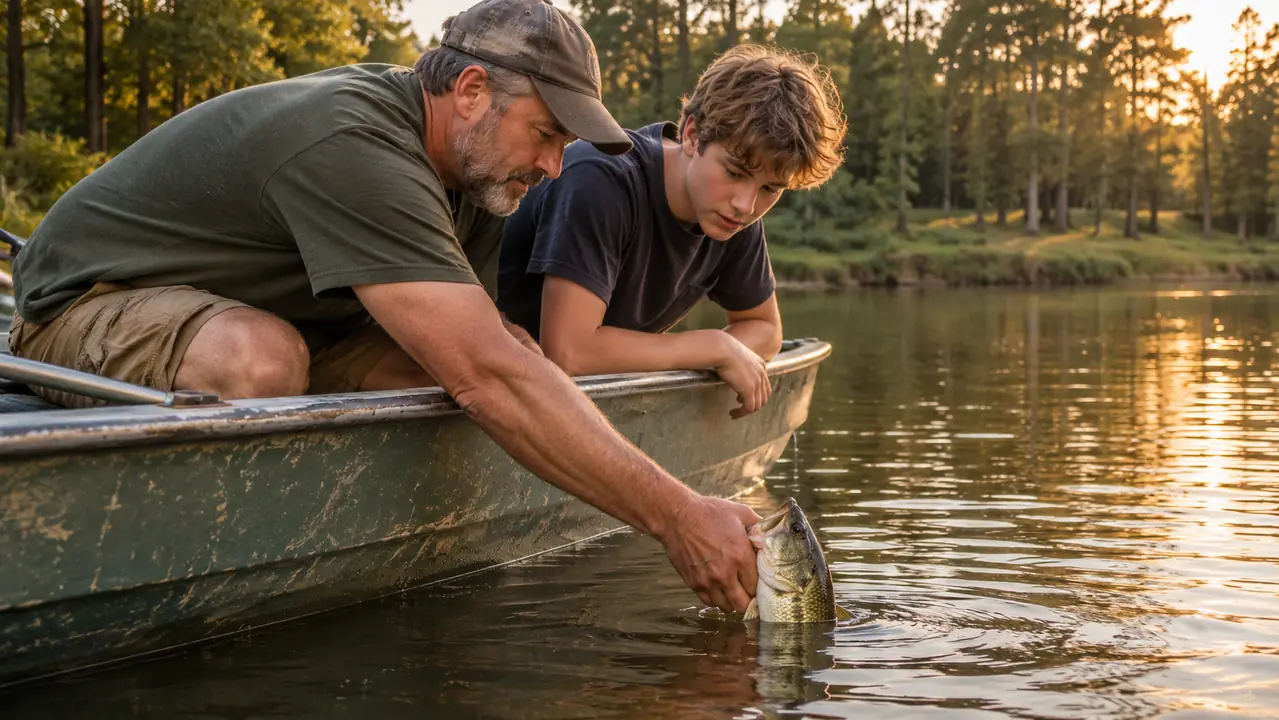
Once the hook is cut or the barb is down, back the pieces out the way they came. Work slow and keep the fish in the water as much as you can. If you are in the boat, hold the fish over the side. If you are on the bank, kneel at the water's edge. The less time the fish spends in the air, the better its chances, and the calmer you are, the calmer the fish is.
When the hook is out, support the fish upright in the water and move it gently back and forth so water pushes over the gills. Do not throw it. Do not drop it. Wait until it swims off on its own. A fish that swims away under its own power is the whole point of going through this trouble instead of just cutting the line and leaving the hook in. I have watched plenty of them go, and it never gets old.
Then rinse the pliers and put them back in the sheath. These are saltwater pliers and I fish fresh water, which means they are overbuilt for my use, and that is exactly how I like a tool. Rinse them, dry them, and they will be ready the next time a fish turns at the wrong moment. On a small boat like mine, the tools that are ready are the tools you reach for.
What Else Helps
A pair of forceps or a dedicated hook remover is a nice thing to have in the boat, and I keep one in the tackle box for the easy hooks that never need the pliers. But when a hook is deep, pliers are the tool, because they give you the grip and the cutting edge in one hand. Forceps push. Pliers push and cut. That makes pliers the right answer for the worst case, and the worst case is the one you need to be ready for.
Beyond the tool, the thing that helps most is pinching your barbs when you fish for fun. A pinch of the pliers on the barb before you cast means the hook comes out easy when it goes in deep, and you barely lose any fish. I do it for most of my bass fishing on Caesar Creek and the farm ponds, and it has saved a lot of fish and a lot of cuss words. Caleb thinks I am being soft. I call it being smart.
And keep the pliers where you can reach them. The pair that lives in the truck does you no good when the fish is bleeding over the side of the boat. Mine ride in the sheath on the bench, and when I fish from the bank, the sheath goes on my belt. It is cheap insurance for a problem that happens fast and never gives you a warning first.
One more thing: know when to call it. If the hook is so deep that getting it out means tearing the gills apart, cut the line at the mouth, leave the hook, and put the fish back. A fish with a hook in it can live a long time. A fish with its gills torn out cannot. The goal is not to get your hook back. The goal is to get the fish back.
The Piscifun pliers weigh 3.6 ounces. That is light enough to live in your pocket all day and heavy enough to cut a hook when you need it.
Get the Pliers Before You Need Them
The Piscifun saltwater pliers are the pair I reach for when a hook is deep and the fish is bleeding. Spring-loaded aluminum jaws, tungsten carbide cutters, 3.6 ounces. Keep them in the boat, and you will never have to watch a fish die over a hook again.
Amazon Check Today's Price on Amazon →